
INSIGHTS
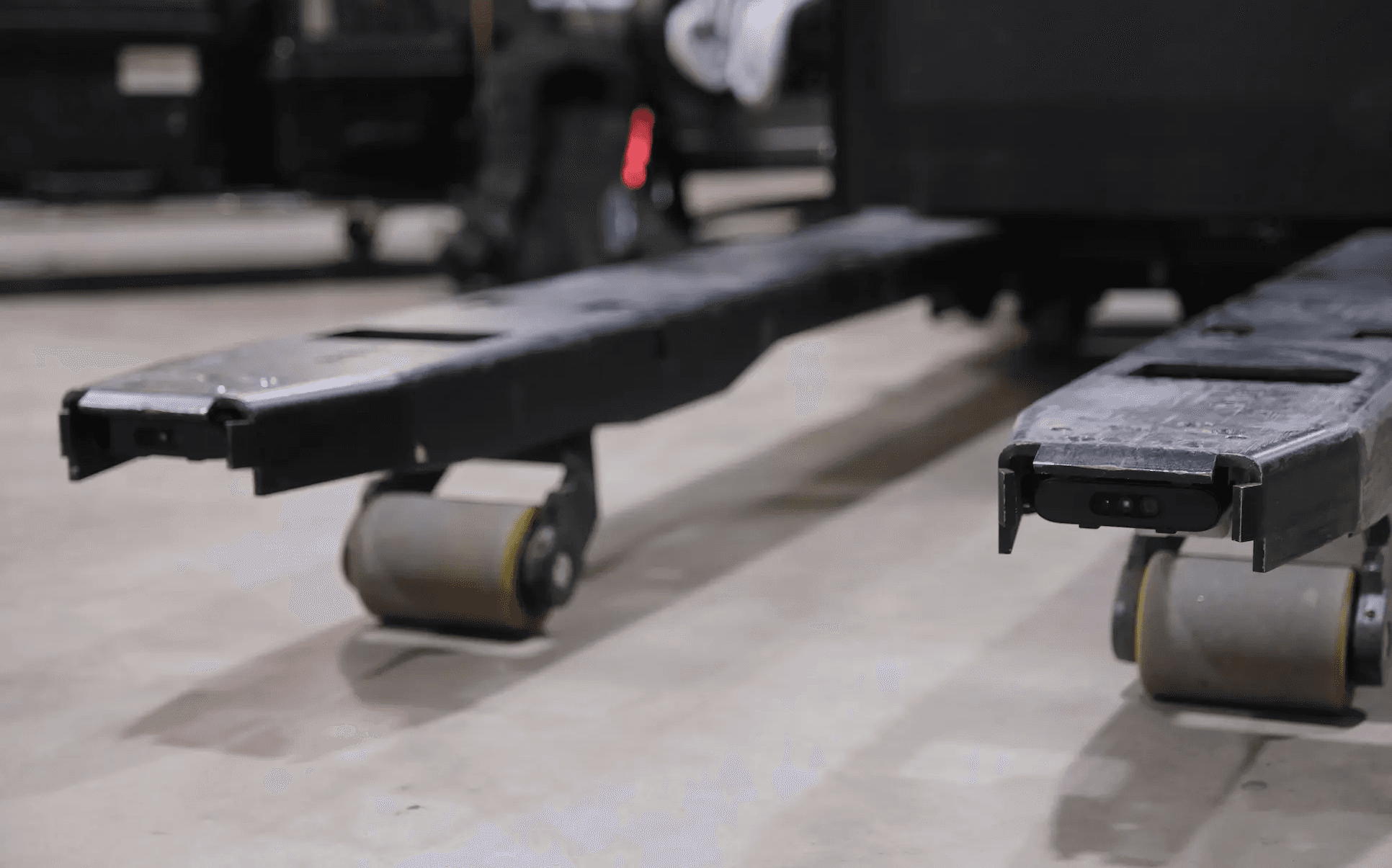

When we built the first generation of our autonomy solutions, the industry standard was clear: 2D safety-rated laser scanners. They were proven, certifiable, and sufficient for a constrained problem definition. Navigate a drivable spae. Stop for an obstacle. Move on.
But as we evolved CoreFlex into a modular platform meant to handle pallet manipulation, visual SLAM, and physical AI inference across arbitrary warehouse environments, that problem definition expanded. And 2D laser-only architectures had a fundamental ceiling.
We needed a depth-sensing foundation that could see the world the way CoreFlex needed to think about it.
Why depth perception changes what CoreFlex can do
There's a meaningful difference between an autonomy stack that avoids its environment and one that understands it. A 2D scanner draws a horizontal slice of the world. A structured depth camera gives you a dense, spatially coherent model of what's actually in front of the machine: geometry, surface structure, context.
For CoreFlex, that difference is operational. Pallet entry geometry varies. Fork alignment demands sub-centimeter precision in three dimensions, not two. Overwrap detection, load confirmation, clearance verification. These are problems that are extremely difficult with a laser line. They require a camera that can generate reliable, high-density depth data in real time, in variable lighting, across the full range of warehouse conditions.
That's what the Orbbec Gemini 336 cameras deliver and why it's now a core component of CoreFlex.
Why we chose Orbbec
We integrated the Gemini 336 into CoreFlex in September 2024, starting with the BPM44 autonomous pallet jack we built in partnership with Big Joe Forklifts. The evaluation wasn't just about specs, it was about what the sensor could anchor inside a modular, cross-platform architecture.
The Gemini 336's dense structured-light imaging gave CoreFlex's physical AI models the perceptual resolution they needed. The swappable filter options meant we weren't designing around lighting constraints on every new deployment. The form factor fit cleanly into CoreFlex's standardized mounting architecture without forcing redesigns for each new vehicle type. And the cost profile was compatible with the economics of deploying at OEM scale. Not just on one machine, but across an entire product line.
It's a rare combination: a sensor that performs like a premium component and prices like a platform decision.
What solidified Orbbec as a partner rather than just a supplier was the support. Early in the integration, Orbbec's team engaged with ours at an engineering level — not just as a vendor managing a PO. That responsiveness matters when you're building production systems and edge cases surface faster than your timeline allows.
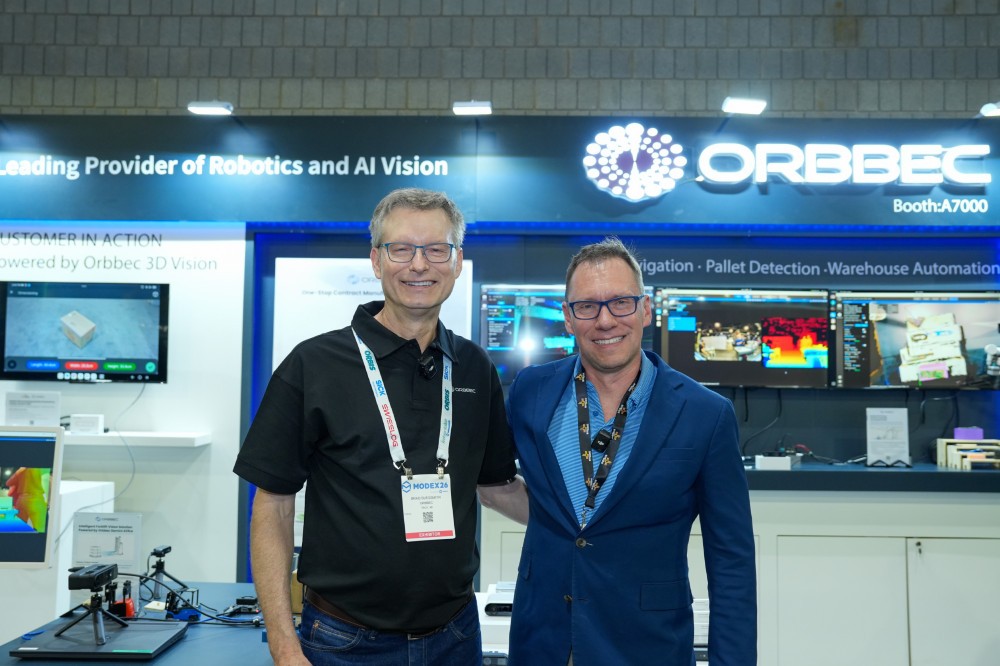
Pictured: Brad Suessmith, Robotics Sales Manager at Orbbec, and Patrick Mondi, CEO of Thoro
“When sensor performance is exceptional, the software fully delivers on its design intent. We commit to providing OEMs worldwide with safe, scalable, and easy-to-use industrial autonomy solutions. Orbbec’s superior hardware and software capabilities give us the confidence to scale applications, and we are excited to expand into new vehicle types and deployment scenarios.”
- Patrick Mondi (CEO, Thoro.ai)
Hear more about Thoro and Orbbec's partnership in practice:
What this means for CoreFlex OEM partners
The Gemini 336 is now validated across the full CoreFlex stack. Our SLAM pipelines, our pallet detection models, our safety-rated stop functions, across multiple vehicle types. For our OEM partners, that validation doesn't restart with each new platform. It compounds.
Every new vehicle type built on CoreFlex inherits the depth perception infrastructure already proven in the field. Faster time to market, lower qualification cost, higher confidence on day one of deployment. That compounding effect is exactly what a modular architecture is designed to produce.
CoreFlex's physical AI models depend on consistent, high-quality depth data as their perceptual substrate. When the sensor layer is stable, the models generalize better, navigation is smoother, and pallet interactions become more reliable. Fewer edge-case failures in the environments that actually matter.
Orbbec's cameras give CoreFlex that stability at scale. This is why they're foundational to the platform, not peripheral to it.
Read Orbbec's perspective on the partnership at orbbec.com. If you're an OEM evaluating CoreFlex, connect with our team.

