
INSIGHTS
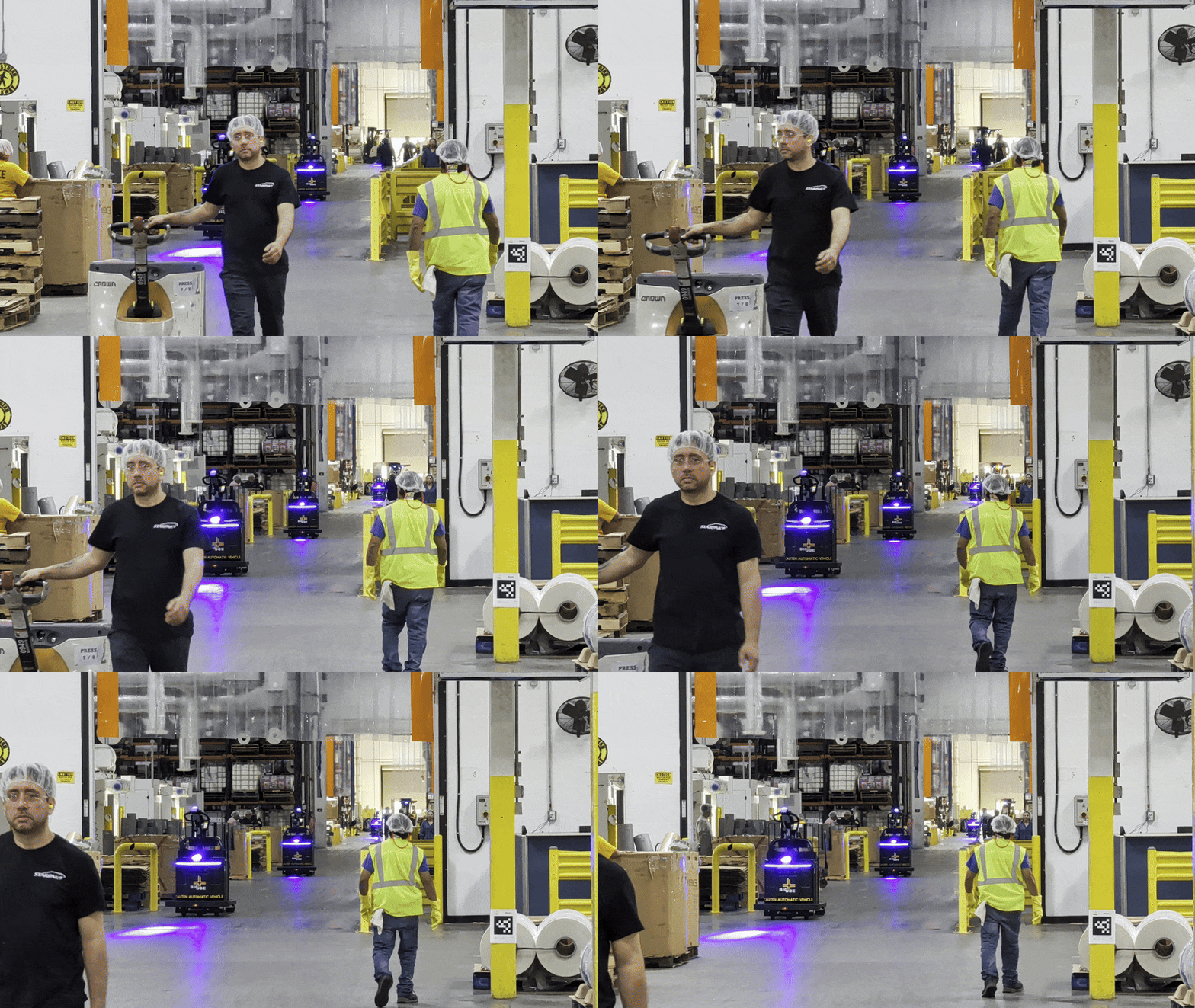

Walk into most warehouses running autonomous mobile robots today and you'll notice something strange. The robots are moving. The metrics say the deployment is live. But ask the operations manager how it's actually going, and the answer is almost always some version of the same thing: "It works, but it's not really solving the problem we bought it for."
This is the automation gap and it's bigger than the industry admits.
Over the past four years, we've had hundreds of conversations with warehouse operators, logistics directors, and OEM partners across distribution centers, manufacturing floors, and fulfillment operations. The stories are remarkably consistent. A company invests in autonomous systems. The pilot looks promising. The full deployment begins. And then, somewhere between go-live and scale, the wheels come off — not the robot's wheels, but the operational ones.
The robots keep moving. The business doesn't change.
We started Thoro because we think we know why this keeps happening. And we think the industry has been solving the wrong problem for the better part of a decade.
The movement trap
The robotics industry, broadly speaking, has built itself around one core question: how do we get a machine from point A to point B reliably?
That is a genuinely hard problem. Localization, obstacle avoidance, path planning, fleet coordination. These are deep technical challenges and the companies that have cracked them deserve real credit. We've spent years working on exactly those problems ourselves.
But here's what gets lost in the pursuit of reliable movement: a robot that moves is not the same thing as a workflow that works.
Think about what actually happens in a busy distribution center. A forklift operator doesn't just drive a forklift. They make dozens of micro-decisions in a single shift: reading dock doors, interpreting WMS alerts, adapting when a bay is blocked, communicating with inbound receiving teams, adjusting pick sequences when inventory is mis-slotted. The movement is the least interesting part of the job. The judgment is everything.
The robot moves. The workflow still requires a human to orchestrate it.
This is why so many "successful" AMR deployments end up as expensive conveyors with wheels. Useful in a narrow, controlled slice of the operation, invisible to the rest.
The 70% problem
Here's a number we come back to constantly: 70%.
Across industrial robotics deployments, roughly 70% of the total cost and operational burden isn't in the technology; it's in everything that surrounds the technology. Implementation. Site-specific configuration. Integration with existing systems. Operator training. Ongoing support and troubleshooting. Adapting when conditions change.
Most robotics companies are built to sell and deploy technology. Very few are built to absorb the 70%.
The result is a structural mismatch. The customer buys a robot. The vendor delivers a robot. And then the customer discovers that what they actually needed was an autonomous workflow, and that the robot, as sold, is only a component of one.
We've seen this play out in real deployments: an enterprise operator brings in autonomous pallet jacks for inbound receiving. The robots work exactly as specified. But the WMS sends tasks in a format the robot doesn't understand. The dock doors the robots need to navigate aren't on the map because the facility did a renovation. The operators who work alongside the robots weren't part of the deployment process and don't trust the system. Three months in, the robots are parked half the time and a human is manually re-routing tasks.
The robot never failed. The deployment did.
What workflow-first actually means
We designed Thoro around a different starting question: what does the workflow actually need?
This sounds obvious until you try to build it. Workflow-first autonomy means several things in practice that genuinely constrain your technology choices.
It means your autonomy has to run on any hardware. Workflows don't care which OEM makes the machine. A pallet transport workflow needs fork truck. But which one depends on the facility, the load type, the aisle width, the existing fleet. If your autonomy stack only runs on one platform, you can't follow the workflow wherever it goes. This is why we built CoreFlex, our modular autonomy architecture, to be platform-agnostic from day one. The same intelligence layer runs on pallet jacks, forklifts, cleaning robots, and tuggers.
It means you have to integrate with the systems operators already use. The warehouse doesn't reorganize itself around your robot. Your robot has to speak the language of the WMS, the ERP, the dock management system.
It means deployment speed is a feature, not a sales claim. If it takes weeks and a team of implementation engineers to go live, operators will never run a meaningful pilot. We've compressed deployment to 1–3 days for most environments specifically because speed is the only thing that makes iteration possible.
Why this matters now
The stakes for getting this right are higher than they've ever been.
Labor dynamics in industrial logistics have fundamentally shifted. The pipeline of workers willing to do physically demanding warehouse work at the wages operators can sustain has been shrinking for years. E-commerce volume keeps growing. The pressure to process more with fewer people isn't going away.
At the same time, the window for autonomous systems to prove themselves at enterprise scale is narrowing. Operators who had bad experiences with first-generation AMR deployments are skeptical. The question isn't "should we automate?," it's "can we find a system that actually does what it promises?"
That pressure is good for companies like Thoro. We've always believed that the real opportunity in industrial autonomy isn't selling robots, it's solving operations. Every robot we deploy is a bet on a specific workflow: that we can make this movement task cheaper, more reliable, and more scalable than any human-operated alternative.
When that bet pays off, it compounds. Each deployment teaches the system something about how that workflow actually behaves, about edge cases in the environment, about the real patterns of how loads move through a facility. That knowledge goes back into the platform, available to the next deployment.
The movement trap is seductive because movement is measurable. It's much harder to prove a workflow is solved
That's the harder problem. It's the one worth solving.

